Planting a tomato plant takes only about ten minutes. But how you plant it affects the whole season. It changes how strong the roots grow, how soon you get fruit, and how many problems you see later.
Here is the short answer. Plant tomatoes outside when the soil is warm, at least 13°C (55°F), and nights stay above 10°C (50°F). Remove the lower leaves and bury the stem so only the top few sets of leaves show. Space supported plants 45 to 90 cm (18 to 36 inches) apart. Water well, add support the same day, and mulch once the soil is warm.
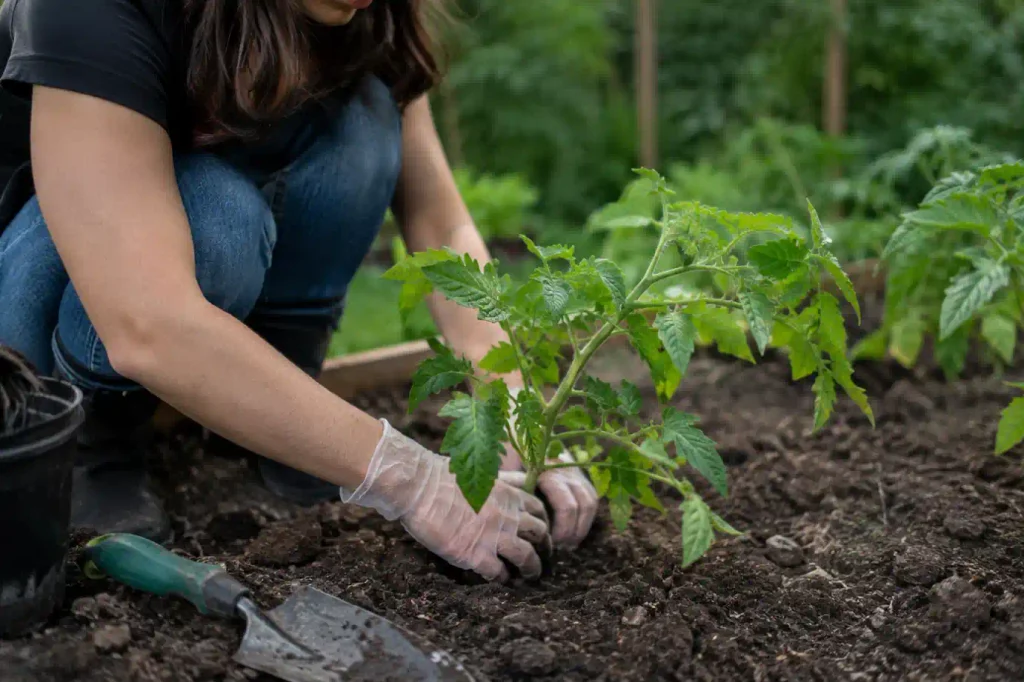
In this guide, I explain how to plant tomato plants properly, step by step, in simple words. I am a botanist (a plant scientist), so I also explain why each step works. Many gardening websites repeat old tips without checking them. Here, I use university studies and farm trials, so you can see which tips really work and which do not.
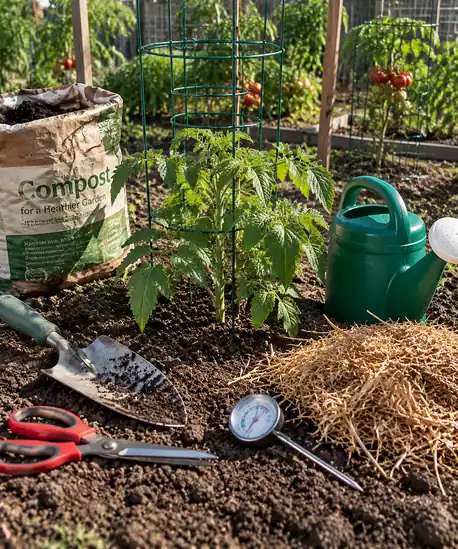
What You Need Before You Plant
Get everything ready before you take the plant out of its pot. Roots dry out very fast in open air.
- Healthy tomato plants
- A small shovel or trowel
- Compost (old, broken-down plant material)
- A stick (stake), cage, or trellis to hold the plant up
- Mulch (straw, dry leaves, or compost)
- A watering can or hose
- A soil thermometer (cheap and very helpful)
- Clean scissors
When to Plant Tomato Plants Outside
The biggest beginner mistake is planting too early. A warm, sunny day does not mean the soil is warm.
Check these three things before you plant:
- No more frost. The cold season is over, and no frost is expected.
- Warm soil. The soil is at least 13°C (55°F), and 16°C (60°F) is even better. Push a soil thermometer about 10 cm (4 inches) into the ground in the morning to check.
- Warm nights. Nights stay above 10°C (50°F).
Colorado State University Extension says the soil must be above 13°C (55°F) for tomato plants to settle in well. It also says one week of cool days can slow the plants and give you fewer tomatoes.
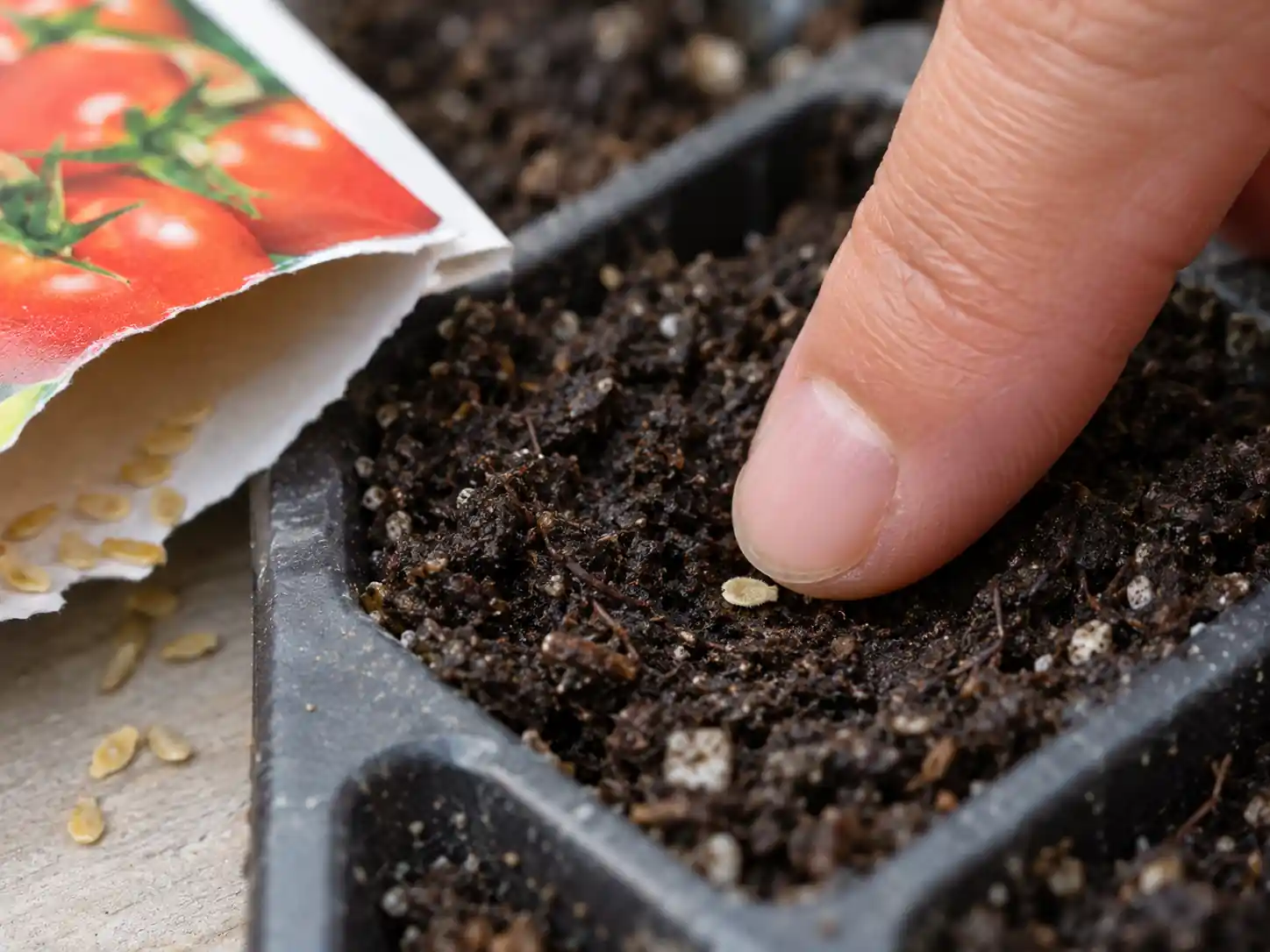
Why This Works: Cold Hurts Tomato Plants
Tomatoes come from warm places. Cold can damage them even when it is not freezing. University of New Hampshire Extension explains that below about 16°C (60°F), tomatoes can get cold damage. This slows their growth and can make the first fruits grow scarred and badly shaped. Cold roots also drink water and take in food slowly. So a plant put into cold soil often stops growing for weeks. A plant put out later, into warm soil, usually grows faster and catches up.
How Big Should Tomato Plants Be to Plant Outside?
A good plant is about 15 to 25 cm (6 to 10 inches) tall, with a thick stem and several sets of leaves. A short, strong plant is better than a tall, thin one.
What Time of Day Is Best to Plant Tomatoes?
Plant on a cloudy day with no wind, or late in the afternoon. University of Maryland Extension suggests a cloudy, calm day so the plant gets less stress. This way, the plant has a cool night to rest before it faces strong sun.
How to Choose Healthy Starter Tomato Plants
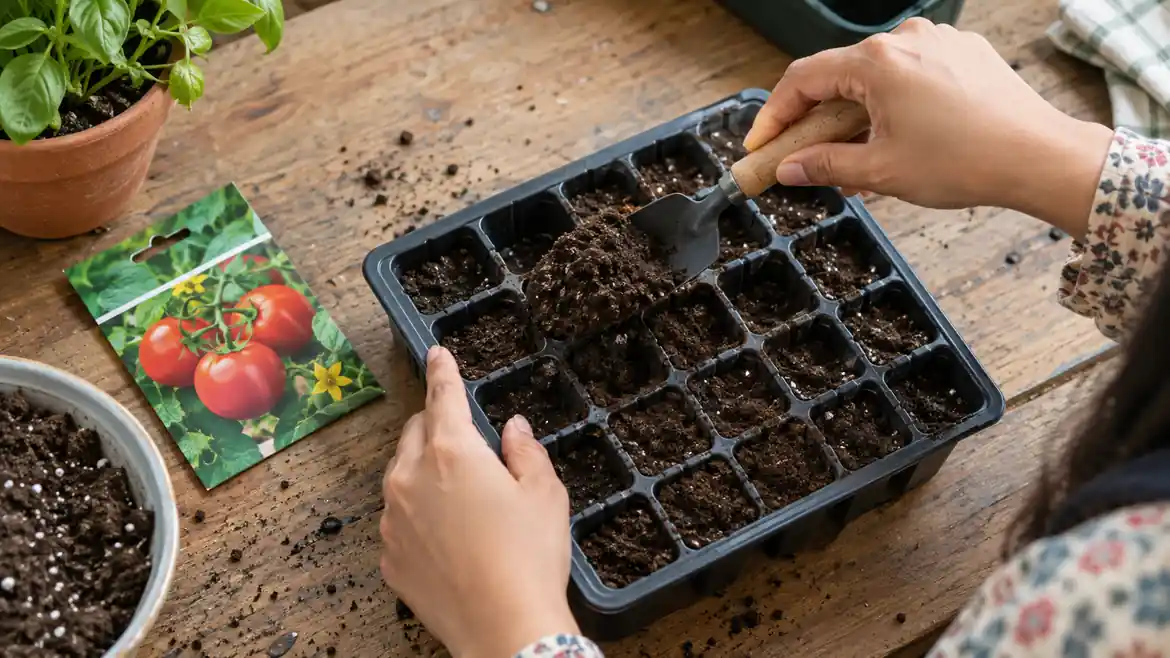
Whether you buy young starter plants or grow them from seed, look for these signs:
- A short, thick stem (not tall and thin)
- Dark green leaves with no yellow or brown spots
- No flowers or fruit yet (if you see flowers, pinch them off before planting)
- White roots that are not tightly wrapped around the inside of the pot
- No insects under the leaves
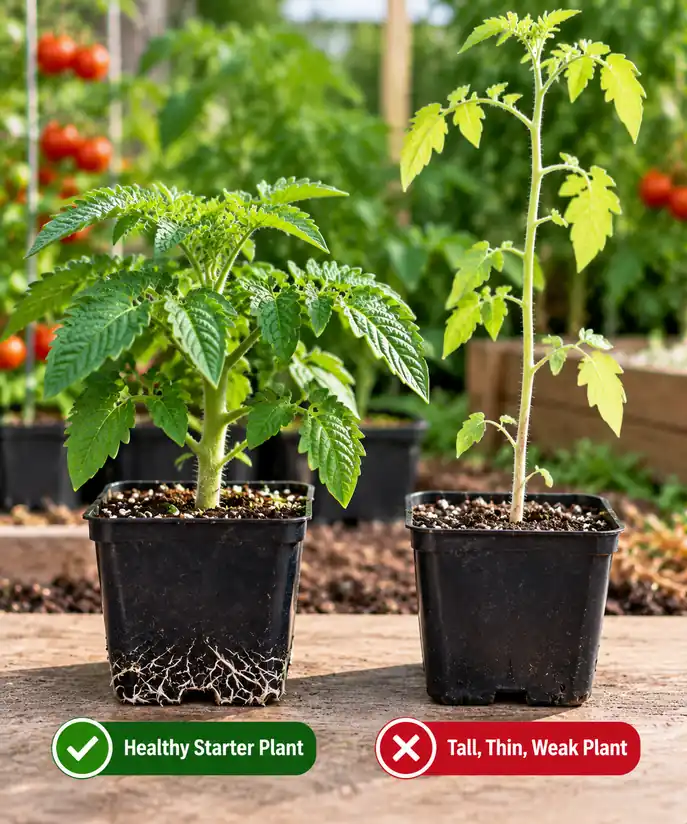
If your plant is already tall and thin, don’t worry. Tomatoes can be planted deep or on their side to fix this. I explain how later in this guide.
How to Prepare Tomato Plants for Outdoor Life (Hardening Off)
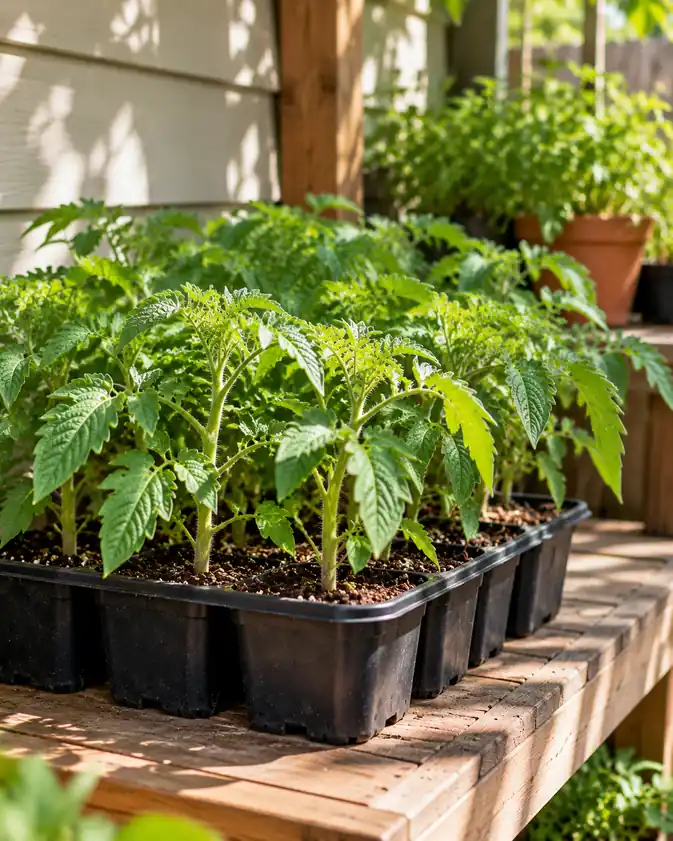
Plants grown indoors have soft leaves. Strong sun, wind, and cold nights can shock them. “Hardening off” means slowly getting the plants used to outdoor life over 7 to 10 days. The day-by-day plan below is my own schedule, built around the extension advice that follows it.
| Day | What to do |
|---|---|
| Days 1 to 2 | Put plants outside in the shade, away from wind, for 1 to 2 hours |
| Days 3 to 4 | Leave them out for 3 to 4 hours, with some morning sun |
| Days 5 to 6 | Leave them out most of the day, with a few hours of direct sun |
| Days 7 to 8 | Leave them out all day in full sun |
| Days 9 to 10 | Leave them out day and night if nights are above 10°C (50°F), then plant |
Bring plants inside if the night will be colder than 10°C (50°F). University of Maryland Extension also says to keep young plants inside on windy days or when it is below 7°C (45°F). Water them often during this time, because small pots dry out fast outside.
Why This Works: What Hardening Off Does Inside the Plant
Hardening off does more than help the plant “get used to” the sun. Experts at Purdue University explain that slow outdoor exposure helps the plant store more sugar (energy), grow more roots, and build thicker, tougher cell walls. A tougher plant with more stored energy survives planting much better. Wind is one of the main causes of damage to new plants, so choose a sheltered spot.
How to Plant Tomato Plants in the Ground: Step by Step
Follow these eight steps in order. Each step has a simple reason behind it.
Step 1Choose a Sunny Spot
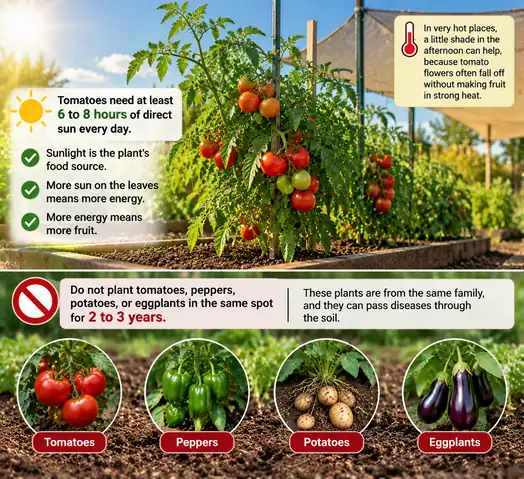
Tomatoes need at least 6 to 8 hours of direct sun every day. Sunlight is the plant’s food source. More sun on the leaves means more energy, and more energy means more fruit. In very hot places, a little shade in the afternoon can help, because tomato flowers often fall off without making fruit in strong heat.
Also, do not plant where tomatoes, peppers, potatoes, or eggplants grew in the last 2 to 3 years. These plants are from the same family, and they can pass diseases through the soil.
Step 2Get the Soil Ready
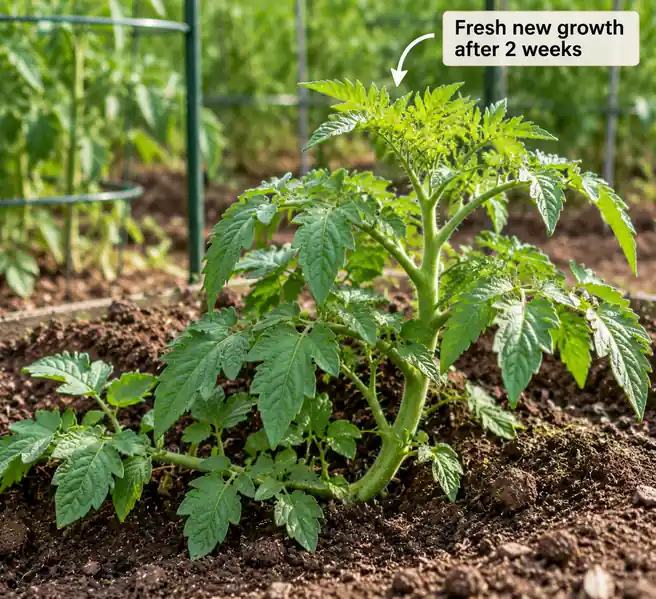
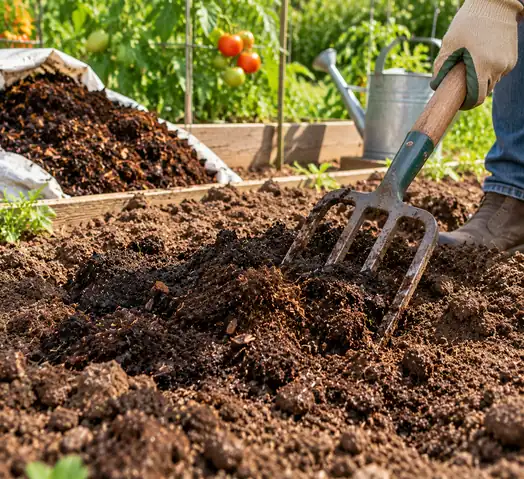
Tomatoes like soft, loose soil that drains water well. Mix about 5 to 8 cm (2 to 3 inches) of compost into the top 20 to 30 cm (8 to 12 inches) of soil. Avoid places where water stays after rain. Roots in wet, soggy soil cannot breathe.
Do not add too much nitrogen fertilizer. Too much nitrogen gives you a big, leafy plant with very few tomatoes. A little compost or a balanced fertilizer is enough.
Step 3Dig the Hole (or a Trench)
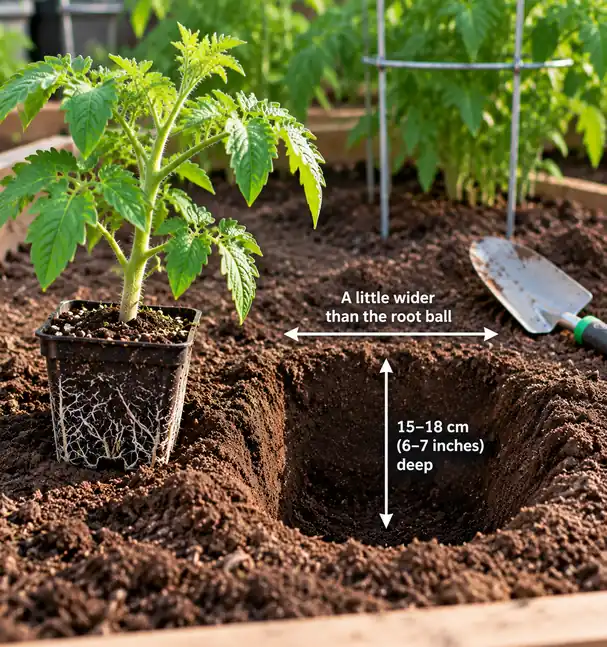
Dig a hole deep enough to bury about two-thirds of the plant. For a plant 25 cm (10 inches) tall, the hole should be about 15 to 18 cm (6 to 7 inches) deep, plus space for the roots. Make the hole a little wider than the root ball, so new roots can grow easily into soft soil.
If your plant is very tall, or your soil is still cold lower down, dig a shallow trench instead. You will lay the plant on its side (see the section on leggy plants below).
Step 4Remove the Lower Leaves
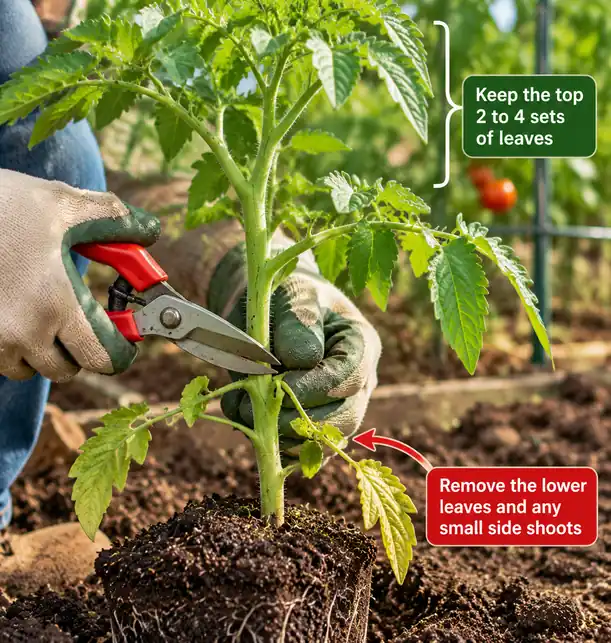
Use clean scissors to cut off all the leaves and small side shoots from the part of the stem that will go under the soil. Keep only the top 2 to 4 sets of leaves. Leaves left under the soil will rot and can bring disease.
Step 5Put the Plant in Deep and Fill the Hole
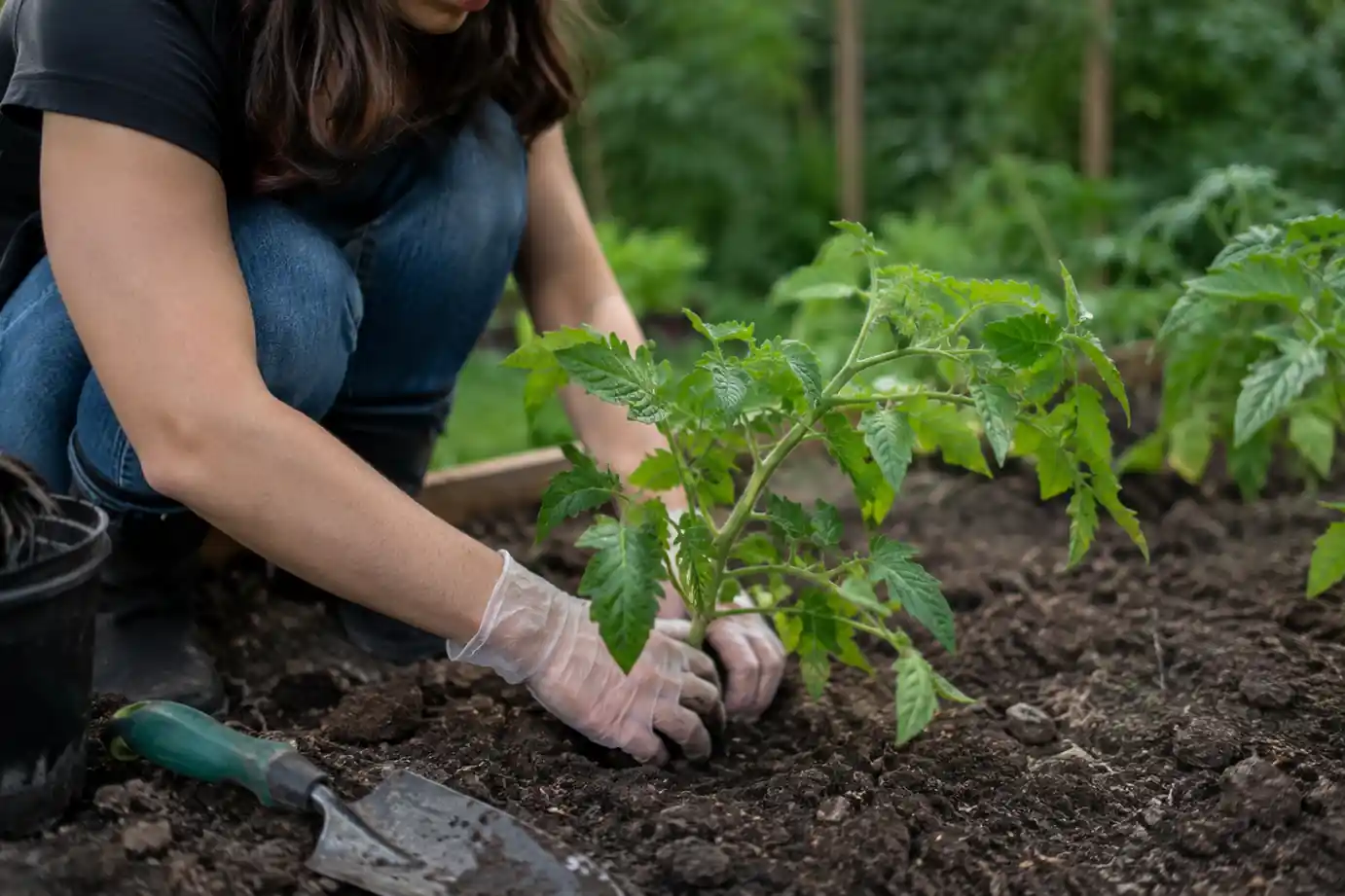
Gently take the plant out of its pot. If the roots are wrapped in circles, loosen them softly with your fingers. Place the plant in the hole so only the top leaves stay above the soil. Fill the hole with soil and press gently to remove air gaps.
Why This Works: Tomatoes Can Grow Roots From Their Stem
Most plants die if you bury their stem. Tomatoes are different. Look closely at a tomato stem and you will see tiny hairs and bumps. When these are covered with moist soil, they turn into new roots. So a buried stem becomes extra roots.
This is not just an old garden story. In farm trials across Florida, University of Florida researcher Charlie Vavrina tested three planting depths: just covering the roots, planting a little deeper, and planting up to the first real leaves. Deeper planting gave more tomatoes in five out of seven trials. Plants buried up to the first real leaves gave the most fruit at the first harvest, and the most extra-large tomatoes.
But here is the honest part. The extra fruit came mostly at the first harvest. Over the whole season, the total harvest was bigger in only two of the five successful trials. Still, in these Florida trials deep planting did not reduce the harvest, though results have been more mixed in other states such as Pennsylvania. It also makes young plants stronger, so they don’t fall over in the wind. So deep planting is a smart and safe habit, but it is not magic.
Step 6Water Deeply
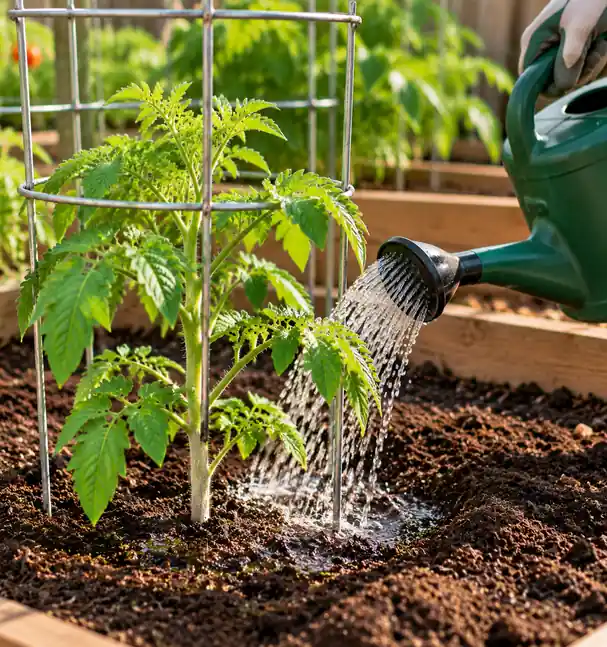
Water slowly at the bottom of the plant until the soil around and below the roots is fully wet. This settles the soil and fills air gaps. Try to keep the leaves dry, because wet leaves help plant diseases spread.
Step 7Add a Cage or Stick the Same Day
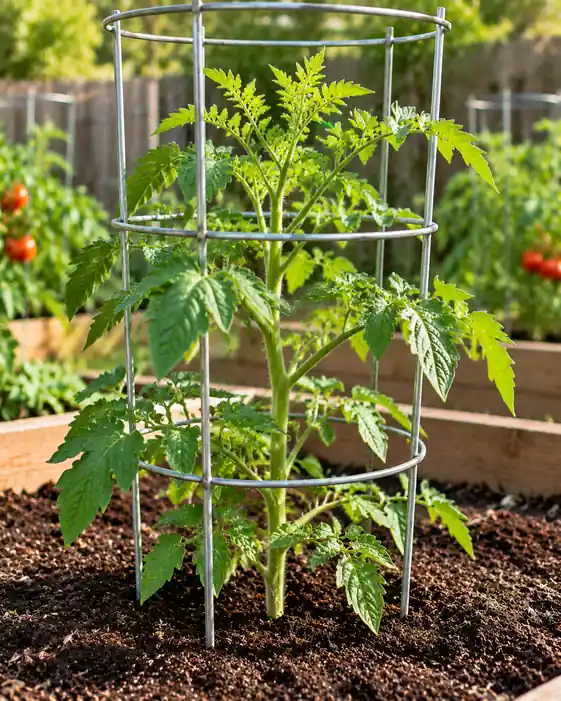
Put your support in on planting day. If you wait until the plant is big, you may push the stick through the roots and damage them. Tall, climbing tomatoes (called “indeterminate”) need a strong stick, cage, or trellis. Short, bushy tomatoes (called “determinate”) still grow better with a small cage.
Step 8Add Mulch When the Soil Is Warm
Spread 5 to 8 cm (2 to 3 inches) of straw, dry leaves, or compost around the plant. Keep it a little away from the stem. Mulch keeps the soil evenly moist, stops soil from splashing onto the leaves, and blocks weeds.
Timing matters. University of New Hampshire Extension explains that straw and leaf mulch keep the soil cool, so wait until the soil is truly warm before you add them. In cold places, black plastic laid on the soil before planting helps warm it up instead.
How Deep to Plant Tomato Plants (Ground, Raised Bed, and Pots)
Bury about two-thirds of the plant. Leave only the top 2 to 4 sets of leaves above the soil. In the Florida trials, planting up to the first real leaves gave the best early harvest.
There is one exception. If the soil is still cold lower down, a very deep hole puts the roots in cold soil. Colorado State University Extension recommends laying tall, thin plants flat in a shallow trench instead. On the Garden Professors blog, a reader also describes digging up a deep-planted tomato and finding most of its roots close to the warm top layer of soil. That fits the advice, but it is one gardener’s observation rather than a trial. So in cool weather or early spring, plant the tomato on its side in a shallow trench. This keeps the buried stem in warmer soil.Garden Professors
| Where you plant | How deep |
|---|---|
| In the ground (warm soil) | Bury two-thirds of the stem, up to the leaves you keep |
| In the ground (cold soil or tall plant) | Lay it on its side in a trench 10 to 15 cm (4 to 6 inches) deep |
| Raised bed | Same as in the ground. Raised beds warm up faster, so deep planting usually works well |
| Pots and containers | Bury as deep as the pot allows, but keep some soil under the roots |
How Far Apart to Plant Tomato Plants
What Do Determinate and Indeterminate Mean?
Determinate tomatoes are short and bushy. They grow to a set size, give most of their fruit over a few weeks, then stop. Indeterminate tomatoes are tall and climbing. They keep growing and keep making fruit until cold weather stops them. The plant label almost always tells you which one you have. Determinate types need less space and a smaller cage. Indeterminate types need more space and a tall, strong support.
The right spacing depends mostly on how you hold the plant up, not only on the type of tomato. The space between plants comes from Iowa State University Extension:Iowa State University Extension
| Tomato type and support | Space between plants | Space between rows |
|---|---|---|
| Short, bushy tomatoes (determinate) | 60 to 75 cm (2 to 2.5 feet) | About 120 cm (4 feet) |
| Tall, climbing tomatoes tied to a stick | 45 to 60 cm (1.5 to 2 feet) | At least 120 cm (4 feet), my guidance |
| Tall, climbing tomatoes in a cage | 75 to 90 cm (2.5 to 3 feet) | At least 120 cm (4 feet), my guidance |
| Tall, climbing tomatoes left on the ground | 90 to 120 cm (3 to 4 feet) | At least 120 cm (4 feet), my guidance |
Iowa State gives the row spacing of about 120 cm (4 feet) for short, bushy tomatoes. For the other types, I suggest at least the same, so you have room to walk, tie, and pick between the rows.
Why This Works: Close Plants Give More Tomatoes, but Smaller Ones
Research shows a clear trade-off. In a 2024 study in the journal Frontiers in Plant Science, tomatoes planted close together gave the most fruit from the same area of ground. But the tomatoes were smaller and lower in quality. Crowded plants had less energy to share, and more of their flowers fell off. Plants with more space gave bigger and better tomatoes, but fewer in total from the same area.
For a home garden with just a few plants, more space is usually better. You get bigger tomatoes, more air around the leaves, and fewer leaf diseases.
The same study also tested a middle path. Starting the plants close together, then moving them further apart as they grew, gave the same fruit quality as wide spacing with more than double the harvest from the same area. You cannot move plants that are already in the ground, but if you grow in pots, you can copy this: start the pots close together and spread them out as the plants fill in.
Can You Plant Two Tomato Plants Together?
It is better not to. Two plants in one hole fight for water, food, and light. You usually get two weak plants instead of one strong plant. The crowded leaves also stay wet longer, which brings disease. Give each plant its own hole or its own pot.
How to Plant Tomato Plants in Pots, Containers, Grow Bags, and Raised Beds
The planting steps are the same. The main difference is how much soil the roots have.
How to Plant Tomato Plants in Pots or a 5 Gallon Bucket
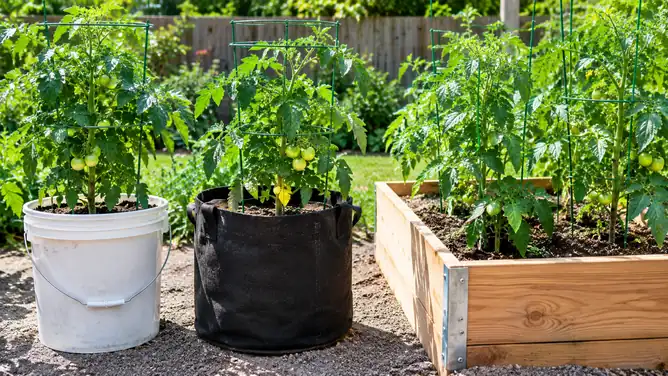
Put one plant in each container, and make sure it has holes in the bottom for water to drain out. University of Wisconsin Extension says short, bushy tomatoes can grow in a 5 gallon (19 liter) container, but tall, climbing tomatoes need a container bigger than a 5 gallon bucket. For big tomato types I suggest 40 to 75 liters (10 to 20 gallons), which works much better. Use potting mix, not garden soil, because garden soil becomes hard and packed in pots.University of Wisconsin Extension
Why This Works: Small Pots Give Sweeter but Fewer Tomatoes
Pot size really changes your harvest. A 2026 study in the journal Agronomy, citing earlier work by Saito and colleagues, notes that when root space was cut from 16 liters to 6 liters (about 4 gallons to 1.5 gallons), tomato plants grew about 26% less. The study’s own trial found that tomatoes with very limited root space made sweeter fruit with deeper red color, but about 29% fewer tomatoes. So a small pot can give tasty tomatoes, just not as many.2026 research review in the journal Agronomy
How to Plant Tomato Plants in Grow Bags
Grow bags are fabric pots. They work well because air can reach the roots. But they also dry out faster than plastic pots. So choose one size bigger (for example, 26 liters or 7 gallons instead of 19 liters or 5 gallons) and check the soil every day in hot weather. This size step is my own rule of thumb, not a research figure.
How to Plant Tomato Plants in a Raised Bed
Raised beds are great for tomatoes. The soil warms up faster in spring, and water drains well. Follow the same steps as planting in the ground, and use the same spacing as the table above.
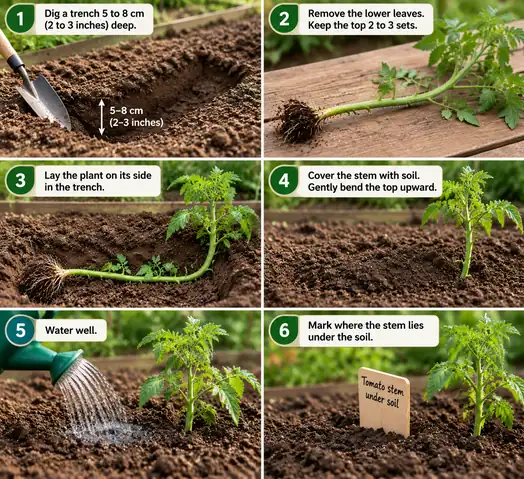
How to Plant Leggy or Tall Tomato Plants Sideways
A leggy tomato plant is one that grew tall and thin, usually from too little light. If your plant is leggy, plant it on its side. Colorado State University Extension recommends laying tall, thin tomato plants flat, because they grow roots along the stem in the warm soil near the top.
- Dig a trench 5 to 8 cm (2 to 3 inches) deep and as long as the stem you want to bury. Colorado State University Extension gives this shallow depth, so the buried stem stays in the warm top layer of soil.
- Cut off the lower leaves. Keep the top 2 to 3 sets.
- Lay the plant on its side in the trench.
- Gently bend the top upward so the leaves stay above the soil. Do not break the stem. The plant will turn itself upward toward the light in a few days.
- Cover the stem with soil and water well.
- Mark where the stem lies under the soil, so you don’t push a stick through it later.
What to Do in the First Two Weeks After Planting
- Expect a short pause. Most new plants stop growing for a few days. This is normal. The plant is growing new roots before it grows new leaves. Some drooping on the first hot afternoon is also normal if the plant looks fine again by evening.
- Water often at first, then less often. Keep the soil evenly moist for the first week. After that, water deeply 1 to 2 times a week. Give about 2.5 cm (1 inch) of water per week, and more in hot weather. Plants in pots need water much more often, sometimes every day.
- Protect from cold nights. If a cold night is coming, cover the plant with a bucket or a garden cloth overnight.
- Wait before adding more fertilizer. If you mixed compost into the soil, wait until the first flowers appear before feeding again.
- Tie the stem loosely to its stick as it grows. Use soft ties, such as strips of cloth.
Common Tomato Planting Mistakes (and What Research Says)
Mistake 1: Planting in Cold Soil
Planting early does not give you early tomatoes. Cold soil slows the roots and can damage the plant. Wait for warm soil, as explained above.
Mistake 2: Putting Eggshells in the Planting Hole
Many gardeners put eggshells in the hole to stop blossom end rot. This is the dark, sunken spot on the bottom of the tomato. Sadly, whole eggshells do not work. University of Illinois Extension explains that whole eggshells break down so slowly in soil that most of their calcium stays locked inside and never reaches the plant in time. Shells ground to a fine powder are different: in one Alabama study, ground shells worked as well as pure calcium sources. But grinding them still will not stop blossom end rot, because the problem is not how much calcium is in your soil. It is how calcium moves inside the plant, as the next section explains.University of Illinois Extension
Why This Works: Blossom End Rot Is a Watering Problem
Blossom end rot happens when the growing tomato does not get enough calcium. But in most gardens, the soil already has plenty of calcium. The real problem is moving calcium inside the plant.
Calcium can only travel with water. Water moves up from the roots through the plant’s water pipes, pulled up as water leaves through the leaves. A research review in Frontiers in Plant Science explains that fruits lose very little water compared with leaves, so they receive much less calcium. When watering is uneven, the leaves take most of the calcium, and the bottom of the fruit gets too little. That is why the rot always starts at the bottom of the tomato.
The real fix is simple. Water evenly, use mulch to keep the soil moist, and don’t use too much nitrogen fertilizer. Extra nitrogen makes extra leaves, and those leaves take calcium away from the fruit.
Mistake 3: Too Much Nitrogen Fertilizer
Fertilizers high in nitrogen make lots of leaves but fewer flowers and tomatoes. Extra leaves also pull calcium away from the fruit, as explained above. Use compost or a balanced fertilizer instead.
Mistake 4: Adding the Stick or Cage Too Late
Pushing a stick into the ground after the roots have spread will damage them. Always add the support on planting day.
Mistake 5: Planting Too Close Together
Crowded plants stay wet longer after rain. This helps leaf diseases like early blight spread. Follow the spacing table above.
Conclusion
Planting a tomato the right way sets the tone for the whole season. Warm soil, a deep hole that lets the stem grow extra roots, the right spacing for your variety, and support added on day one all work together. None of these steps take much extra time, and each one is backed by real university trials, not just old garden habit.
Get these basics right, and your plants spend their energy growing roots and fruit instead of fighting cold soil, crowded neighbors, or a support stake pushed in too late. The first two weeks after planting are the ones that matter most, so keep an eye on watering and give your plants some shade on the hottest afternoons if they start to droop.
Frequently Asked Questions
About the Author
Farkhanda Maqsood has an M.Phil degree in Botany (plant science). Her research is on how plants and soil work together. She writes easy guides on growing vegetables, explaining not only what to do but why it works. Every key claim is linked to university research or published studies.
Sources
- Vavrina, C. “Tomato Transplanting Reaches New Depths.” University of Florida IFAS, Southwest Florida Research and Education Center.
- Colorado State University Extension. CMG GardenNotes #717: Growing Tomatoes.
- University of New Hampshire Extension. Growing Vegetables: Tomatoes (fact sheet).
- University of Maryland Extension. Planting Vegetable Transplants.
- Purdue University Vegetable Crops Hotline. Setting Your Transplants Up for Success.
- Iowa State University Extension. What is the proper spacing when planting tomatoes in the garden?
- University of Wisconsin Extension. Growing a Tomato Plant in a Container.
- University of Illinois Extension. Using Eggshells in the Garden and Compost.
- Frontiers in Plant Science (2016). Fruit Calcium: Transport and Physiology.
- Frontiers in Plant Science (2024). Dynamic plant spacing in tomato results in high yields while mitigating the reduction in fruit quality associated with high planting densities.
- Agronomy (2026). Effects of Substrate-Based Root Restriction on Tomato Growth, Fruit Quality, Yield, and Microbial Communities.
- Garden Professors. Our visiting professor digs into tomato planting depth.